
eIDAS Compliant Signatures for Law Firms: 2026 Guide

eIDAS compliant electronic signatures are defined as legally recognized digital authentication methods that meet the requirements of the EU’s Electronic Identification, Authentication and Trust Services Regulation. For UK law firms handling cross-border matters or EU-facing clients, selecting the right signature tier under eIDAS is not optional. The regulation establishes three tiers: Simple Electronic Signatures (SES), Advanced Electronic Signatures (AES), and Qualified Electronic Signatures (QES). Each tier carries a different legal weight, and applying the wrong one to the wrong document creates real liability. SignFlow Now is built specifically to help solicitors navigate these distinctions without guesswork.
What are the different types of eIDAS electronic signatures for law firms?
eIDAS defines three tiers of electronic signatures, and AES is the practical default for most private law work, with QES required for formal deeds. Understanding where each tier applies protects your firm from signature invalidity and the delays that follow.
Simple Electronic Signatures (SES) carry the lowest legal threshold. A typed name at the bottom of an email or a scanned image of a handwritten signature qualifies. Up to 80% of a typical law firm’s document volume can be handled with SES paired with a strong audit trail. That figure covers engagement letters, client care letters, and routine correspondence where the identity of the signer is not seriously in dispute.
Advanced Electronic Signatures (AES) require a unique link to the signatory, the ability to detect any subsequent changes to the document, and creation using data under the signatory’s sole control. AES is appropriate for commercial contracts, settlement agreements, and property transaction documents where the parties need stronger evidence of authenticity. Most reputable e-signature platforms issue AES by default for business documents.

Qualified Electronic Signatures (QES) carry the highest legal weight. Under eIDAS Article 25.2, QES has the equivalent legal effect of a handwritten signature across all EU member states. That equivalence is significant. QES requires a qualified certificate issued by a trust service provider listed on an EU member state’s trusted list, plus a secure signature creation device. Statutory filings, formal deeds, and cross-border judicial documents typically require QES.
Some documents fall entirely outside the eIDAS framework. Wills, lasting powers of attorney, and notarized deeds still require wet signatures under UK law. For a full breakdown of UK signature exceptions, solicitors should review the specific statutory requirements before substituting any electronic method.
| Document Type | Recommended Signature Level |
|---|---|
| Engagement and client care letters | SES |
| Commercial contracts and NDAs | AES |
| Property transaction documents | AES |
| Statutory filings and formal deeds | QES |
| Wills, LPAs, notarized deeds | Wet signature required |
Pro Tip: Never assume that a platform’s default signature type meets the level required for a specific document. Confirm the tier in writing with your platform provider before sending any document that carries statutory or regulatory weight.
What tools and prerequisites do law firms need for eIDAS compliance?
Adopting eIDAS compliant legal services requires more than purchasing an e-signature subscription. The technical and procedural infrastructure underneath the signature determines whether it will hold up in court or under a regulatory audit.
The non-negotiable prerequisites are:
-
Qualified trust service providers. Your platform must issue certificates from a provider listed on an EU or UK trusted list. Without this, QES is not achievable and AES may not meet the evidentiary standard required.
-
GDPR-compliant audit trails. Every signing event must generate a timestamped log of who signed, when, from which IP address, and what document version was presented. EU data residency for audit trails is critical to avoid GDPR violations and conflicts with extraterritorial laws like the US Cloud Act.
-
Qualified timestamps. A qualified timestamp proves that a document existed in a specific state at a specific moment. Platforms integrating qualified timestamps and audit trails survive court and tax-audit scrutiny better than those relying on server logs alone.
-
Tamper evidence. The signed document must be cryptographically sealed so that any post-signature alteration is immediately detectable.
-
Client identity verification. For AES and QES, the platform must support identity verification at the point of signing, whether through document upload, biometric check, or, increasingly, digital identity wallets.
Integration with your existing case management system matters as much as the signature itself. Automatic filing of signed PDFs to the correct case file reduces manual errors and directly supports compliance. Platforms that require manual download and re-upload introduce exactly the kind of handling error that creates audit exposure.
Pro Tip: Before committing to any platform, ask the vendor to confirm in writing that audit trail data is stored on EU or UK infrastructure. A vendor that cannot answer this question clearly is not a safe choice for cross-border legal work.
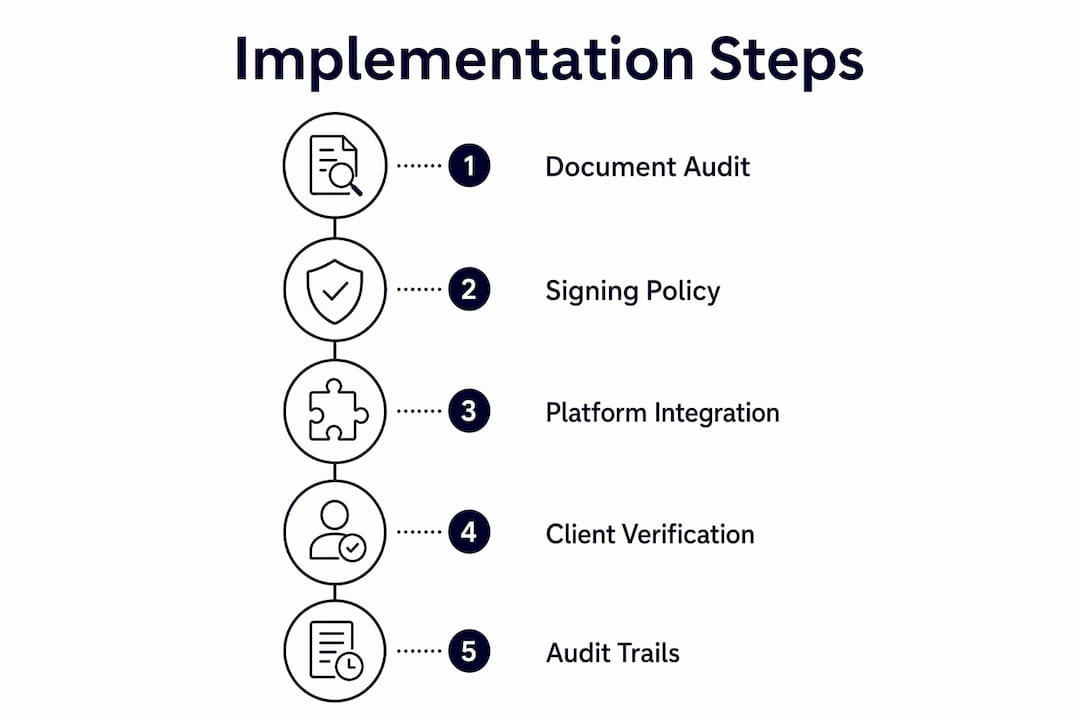
How can law firms implement eIDAS compliant signatures step by step?
Implementation is straightforward when approached in the right sequence. Rushing to deploy before mapping your document types is the most common cause of compliance gaps.
-
Audit your current document workflows. List every document type your firm sends for signature. Categorize each by the legal weight it carries and the statutory requirements that apply.
-
Assign a signature level to each document category. Use the SES, AES, and QES framework to match each document type to the appropriate tier. This mapping becomes your firm’s internal signing policy.
-
Select a compliant platform. The platform must support all three signature tiers, issue certificates from a recognized trust service provider, store audit trails on EU or UK infrastructure, and provide qualified timestamps. Investment in e-signature systems often pays back in under 6 months for firms processing 50 or more contracts per month.
-
Integrate with your practice management software. E-signature solutions that automatically associate signed documents with cases in management systems avoid manual errors and support compliance. Confirm that your chosen platform offers a direct integration or a reliable API connection.
-
Train your staff. Every fee earner and support staff member who sends documents for signature must understand which tier applies to which document. A one-hour training session with a written reference guide is sufficient for most firms.
-
Inform your clients. Send a brief client communication explaining the new process, what they will receive, and how to complete signing. Client confusion at the point of signing is the most common cause of abandoned signature requests.
-
Monitor and audit continuously. Review your audit trail logs monthly. Confirm that signed documents are filing correctly to case management. Spot-check that the correct signature tier is being applied to each document category.
| Implementation Stage | Key Requirement |
|---|---|
| Document audit | Complete list of document types and statutory requirements |
| Signature mapping | Written internal policy assigning tiers to document categories |
| Platform selection | EU or UK data residency, qualified timestamps, trust service provider |
| Integration | Direct connection to practice management system |
| Ongoing monitoring | Monthly audit trail review and compliance spot-checks |
Pro Tip: Build your signing policy into your practice management system as a workflow rule, not a staff memory exercise. Automated prompts that flag the required signature tier before a document is sent remove the most common source of human error.
What are common implementation challenges and how can law firms avoid them?
The most frequent implementation failures are procedural, not technical. Knowing where other firms have gone wrong lets you avoid the same traps.
Failure to ensure document completeness before sending for signature is a leading cause of signature invalidity and delays. A document that is amended after a signing request is issued requires the entire process to restart. Lock document versions before issuing any signing request, and confirm that all annexures and schedules are attached.
Data residency is the second major risk area. The residency of audit trails and signed documents within the EU is as legally critical as the eIDAS compliance of the signature itself. If your audit trail data sits on US-based infrastructure, it may be subject to a US Cloud Act request, which creates a direct conflict with your GDPR obligations. This is not a theoretical risk. It has been the basis for regulatory inquiries in several EU jurisdictions.
Qualified timestamps are frequently overlooked during platform selection. A server log showing a signing time is not the same as a qualified timestamp. Only a qualified timestamp issued by a trust service provider carries the evidentiary weight needed to prove document integrity in litigation.
Compliance by design means moving beyond generic tools to platforms providing qualified timestamps and audit dossiers that ensure legal defensibility. A platform that cannot produce a complete, court-ready audit dossier on demand is not fit for law firm use.
Finally, avoid platforms that do not integrate directly with your case management system. Manual document handling between systems is where errors accumulate and where compliance gaps appear during audits.
How will eIDAS 2.0 affect UK law firms’ electronic signature practices?
eIDAS 2.0 introduces changes that will directly affect how law firms verify client identity and handle cross-border documents. The timeline is firm and the operational implications are significant.
By December 2026, all EU member states must provide digital identity wallets as part of eIDAS 2.0. These wallets allow individuals to store and share verified identity credentials across borders without repeating identity verification for each transaction. For law firms handling EU clients or cross-border matters, this changes the client onboarding process materially.
The key changes law firms should prepare for now:
-
Digital identity wallet integration. Your e-signature platform will need to accept identity credentials presented via EU digital identity wallets. Confirm your vendor’s roadmap for this capability.
-
Cross-border trust verification. eIDAS 2.0 extends the trusted list framework, meaning qualified certificates issued in one EU member state will carry automatic recognition across all others. This simplifies cross-border QES workflows significantly.
-
Cryptographic proof of origin. The EU’s digital justice strategy for 2025–2030 requires cryptographic evidence in judicial proceedings. Law firms handling litigation with EU dimensions must ensure their platforms generate cryptographically verifiable audit trails, not just PDF logs.
-
Client verification workflow updates. Legal professionals must consider client ID verification evolving with eIDAS 2.0’s digital identity wallets. Firms that have not yet integrated digital identity verification into their onboarding process will face a compliance gap as wallet-based verification becomes the expected standard.
Firms that begin platform evaluation now, specifically asking vendors about eIDAS 2.0 readiness, will avoid a forced migration under deadline pressure in late 2026.
Key takeaways
eIDAS compliant electronic signatures require law firms to match the correct signature tier to each document type, store audit trails on EU or UK infrastructure, and select a platform that issues qualified timestamps from a recognized trust service provider.
| Point | Details |
|---|---|
| Three signature tiers apply | SES, AES, and QES each serve different document types and carry different legal weight. |
| Data residency is non-negotiable | Audit trails must reside on EU or UK infrastructure to satisfy GDPR and avoid Cloud Act conflicts. |
| Qualified timestamps are required | Only timestamps from a trust service provider carry the evidentiary weight needed in litigation. |
| eIDAS 2.0 changes client verification | Digital identity wallets become mandatory across EU member states by December 2026. |
| Integration prevents compliance gaps | Platforms that file signed documents directly to case management systems reduce manual errors and audit exposure. |
The adoption gap no one in legal talks about openly
Many legal firms remain slow to adopt eIDAS signatures internally despite advising clients on digital compliance. I have seen this pattern repeatedly. A firm will spend six months advising a corporate client on their e-signature policy while still circulating PDF attachments internally for wet signature and postal return. The paradox is real, and it is costing firms billable time and client confidence.
The firms that move first gain a measurable advantage. Client onboarding that previously took five to seven days shrinks to same-day completion when engagement letters go out via a properly configured e-signature platform. That is not a marginal efficiency gain. It is a structural change in how quickly a firm can open a matter and begin billing.
What I find most firms underestimate is the litigation value of a proper audit trail. A qualified timestamp and a complete audit dossier do not just satisfy a regulator. They win arguments. When a counterparty disputes whether a document was signed, or when it was signed, a court-ready audit dossier from a compliant platform closes that argument immediately. Generic tools that produce only a PDF certificate do not provide the same protection.
My honest recommendation is to treat platform selection as a legal risk decision, not a technology procurement exercise. The question is not which platform is cheapest or easiest to deploy. The question is which platform will protect your firm when a signed document is challenged in court or scrutinized by a regulator. That framing changes the evaluation criteria entirely.
— SignFlow Now
SignFlowNow: built for UK law firms that need eIDAS compliance now
SignFlow Now is an AI-native e-signature and compliance platform built specifically for solicitors and legal professionals operating under UK and EU regulatory frameworks.
SignFlow Now delivers litigation-grade audit trails, qualified timestamps, and GDPR-compliant data residency as standard. The platform supports all three eIDAS signature tiers and integrates directly with practice management systems to eliminate manual document handling. Built-in AML screening and client onboarding packs mean your firm can move from first contact to signed engagement letter without switching between systems. For firms preparing for eIDAS 2.0 requirements, SignFlow Now’s roadmap includes digital identity wallet support ahead of the December 2026 deadline. Visit SignFlow Now for law firms to see how the platform fits your practice.
FAQ
What is the legal status of eIDAS compliant signatures in the UK?
Electronic signatures are legally valid for the vast majority of UK law firm documents under both UK and EU frameworks, with exceptions for wills, notarized deeds, and certain statutory instruments that still require wet signatures.
Which eIDAS signature level do solicitors need for commercial contracts?
Advanced Electronic Signatures (AES) are the appropriate level for most commercial contracts, settlement agreements, and property transaction documents where a stronger evidentiary standard is required.
Does QES replace a handwritten signature under eIDAS?
Yes. Under eIDAS Article 25.2, a Qualified Electronic Signature has the equivalent legal effect of a handwritten signature across all EU member states, provided it is issued by a qualified trust service provider.
How does eIDAS 2.0 affect client onboarding for law firms?
eIDAS 2.0 requires all EU member states to provide digital identity wallets by December 2026, which will change how law firms verify client identity for cross-border matters and AML compliance.
How do I choose a digital signature provider as a law firm?
Select a provider that supports all three eIDAS signature tiers, stores audit trails on EU or UK infrastructure, issues qualified timestamps from a recognized trust service provider, and integrates directly with your practice management system.
Recommended
-
eIDAS 2.0: What the EU’s Updated E-Signature Regulation Means for Your Business | SignFlow Now
-
The Best DocuSign Alternative for UK Law Firms in 2026 | SignFlow Now
-
Are Electronic Signatures Legally Binding in the UK? The Definitive Answer | SignFlow Now
-
Are Electronic Signatures Legal in the US? ESIGN vs UETA Explained | SignFlow Now