
Power of attorney e-signature rules: a practical guide

Power of attorney e-signature rules define when and how an electronic signature can legally bind one of the most consequential documents a person will ever sign. A power of attorney (POA) grants another individual the legal authority to act on your behalf, whether for financial decisions, healthcare choices, or tax matters. Electronic signatures are legally valid for most POAs in the United States, but validity depends on a layered set of federal and state laws, document type, and the policies of the institution receiving the document. Standards including the ESIGN Act, UETA, and the Uniform Power of Attorney Act each play a role, and Remote Online Notarisation (RON) has emerged as the most practical mechanism for meeting witnessing and notarisation requirements electronically.
What laws govern power of attorney e-signature rules?
The legal framework for an e-signature for power of attorney operates at two levels: federal and state. Understanding both is non-negotiable before you sign anything electronically.
At the federal level, the Electronic Signatures in Global and National Commerce Act (ESIGN Act) and the Uniform Electronic Transactions Act (UETA) establish that e-signatures cannot be denied legal effect solely because they are electronic. That is a strong foundation. The critical limitation, however, is that neither statute overrides state-specific execution formalities. If your state requires two witnesses and a notary for a valid POA, those requirements remain in force regardless of whether the signature is wet ink or digital.
State laws impose the real variation. The following points capture the key distinctions you need to know:
- Financial POAs are broadly accepted under general e-signature laws in most US states, provided execution formalities are met.
- Healthcare POAs carry stricter conditions. Many states exclude them from standard e-signature statutes, meaning healthcare POAs require separate compliance with state health law execution rules.
- Witness requirements vary from zero to two witnesses depending on the state, and some states specify that witnesses must be physically present.
- Notarisation requirements are not uniform. Some states mandate notarisation for all POAs; others require it only for real property transactions or durable POAs.
- The Uniform Power of Attorney Act, adopted in varying forms across multiple states, provides a baseline framework but does not harmonise execution rules nationally.
The practical consequence is that a POA signed electronically in one state may be valid there but unenforceable in another. If your POA will be used across state lines, you must verify the execution requirements of every relevant jurisdiction.
How do witnessing and notarisation affect electronic POA signing?

Witnessing and notarisation requirements are the most common reason an otherwise valid online power of attorney signature fails. These are substantive legal requirements, not procedural technicalities, and e-signature laws do not override them.
Remote Online Notarisation has become the most widely used solution. RON allows the principal, notary, and witnesses to complete the entire signing process via a secure video call, satisfying presence requirements without anyone being in the same room. The process works as follows:
- Schedule a RON session with a commissioned notary on a state-approved RON platform that supports identity verification.
- Complete identity verification through knowledge-based authentication and a government-issued photo ID check before the session begins.
- Join the video call with the notary and any required witnesses, all of whom must be visible and audible throughout.
- Sign the document electronically within the platform while the notary observes in real time.
- Receive the notarised electronic document, which includes a tamper-evident seal and an audit trail recording the session.
RON sessions typically cost £20–£40 (approximately $25–$50), covering the notary fee and the technology charge for the platform. That is a modest sum given the legal protection it provides.
Maryland offers a useful example of how states regulate electronic presence. Maryland law permits witnesses to be present electronically, provided both the principal and witnesses are physically located in the United States during signing. Maryland also requires that a supervising attorney create a “certified power of attorney” when electronic signatures and remote witnessing are used, adding a formal validation layer.
Pro Tip: Always confirm that your chosen RON platform is approved in the state where the POA will be executed and, separately, in the state where it will be used. Approval lists differ.
Healthcare POAs warrant particular caution. Many states apply stricter execution rules to healthcare directives than to financial POAs, and some explicitly exclude them from RON provisions. Consult a solicitor or attorney before executing a healthcare POA electronically.
What practical challenges affect the validity of electronically signed POAs?
Legal validity and institutional acceptance are two different things. Banks and healthcare providers frequently reject electronic POAs despite their legal validity, applying internal policies that exceed statutory minimums. This is the most common real-world obstacle you will face.
The following challenges arise regularly:
- Bank refusals. Many high-street and retail banks maintain internal policies requiring wet-ink, notarised originals for POA transactions, regardless of state law.
- Hospital and care facility policies. Healthcare institutions often require paper originals for healthcare POAs, particularly when the principal is incapacitated.
- Government agency requirements. Some state and federal agencies specify their own acceptance criteria, which may not align with general e-signature law.
- Certified POA requirements. States such as Maryland require a supervising attorney to certify electronically executed POAs, which adds time and cost if not planned for in advance.
- Cross-border complications. A POA executed under one state’s electronic rules may not satisfy the execution standards of another state’s receiving institution.
Verifying the exact acceptance requirements of the institution that will receive your POA is as important as meeting the legal execution requirements. A document that is legally valid but institutionally rejected achieves nothing. Contact the bank, hospital, or agency before signing to confirm what format they will accept.
The safest practical approach is to produce both an electronic version and a wet-ink notarised copy. Keep high-resolution PDF records of the electronic version, including the full audit trail, and retain at least two certified paper copies. This dual approach protects you if an institution refuses the electronic document without warning.
What are the best practices for executing a POA with an electronic signature?
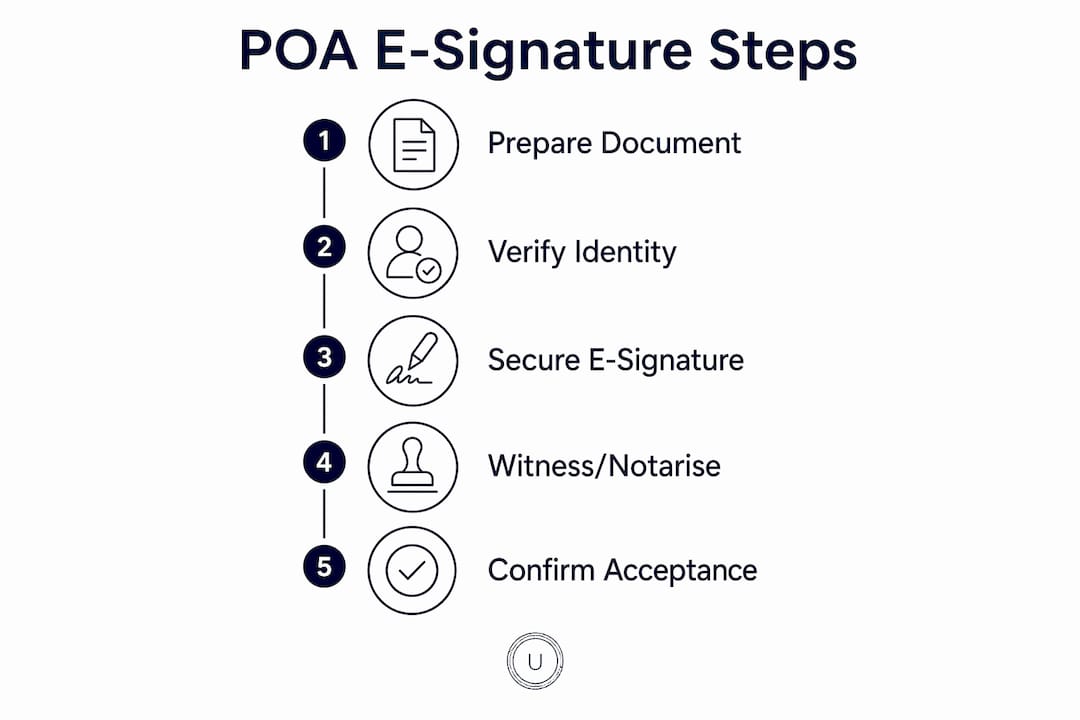
Executing a POA electronically requires more preparation than a standard contract. The following steps reflect the requirements for e-signing power of attorney documents in a way that holds up legally and institutionally.
- Verify the principal’s mental capacity. The principal must have full legal capacity at the moment of signing. Document this clearly, particularly for durable POAs intended to survive incapacity.
- Confirm state-specific requirements. Check whether your state requires witnesses, a notary, or a certified POA for the document type you are executing. Requirements differ for financial, healthcare, and tax POAs.
- Choose a compliant e-signature platform. The platform must display the full document before signing, record the principal’s affirmative action, and generate a tamper-evident audit trail. The principal must demonstrate clear intent to sign; clicking an ambiguous “I agree” button does not constitute a valid signature.
- Arrange RON if notarisation is required. Book a RON session on a state-approved platform and confirm that all parties will be in the required jurisdiction during the session.
- Verify institutional acceptance in advance. Contact every organisation that will receive the POA and confirm their format requirements before signing.
- Retain multiple copies. Store high-resolution PDFs with audit trails and produce wet-ink notarised copies where institutions require them.
Pro Tip: If you are executing a POA for use with a financial institution, ask the institution for its specific POA acceptance policy in writing before you proceed. This prevents disputes after the fact.
Seeking legal advice is prudent for any POA that involves significant assets, healthcare decisions, or cross-jurisdictional use. The cost of a brief consultation is negligible compared to the cost of an invalid document.
How are recent legal changes shaping POA e-signature acceptance?
Legislative change is accelerating. New York’s legislation effective april 2026 authorises electronic signatures for tax powers of attorney submitted to state finance departments, treating e-signatures as legally equivalent to handwritten signatures. This makes it materially easier for taxpayer representatives and their clients to complete and submit tax POA documents without wet-ink formalities.
Maryland’s framework, by contrast, illustrates how states can permit electronic execution whilst maintaining rigorous safeguards. Maryland requires that all parties, including witnesses, be physically located in the United States during a RON session, and mandates a supervising attorney to create a certified POA when remote witnessing is used.
| Jurisdiction | Electronic POA permitted | Key requirement | Document type |
|---|---|---|---|
| New York | Yes (from april 2026) | E-signature treated as equivalent to wet ink | Tax POA |
| Maryland | Yes | Certified POA by supervising attorney; US presence required | Financial POA |
| Most US states | Yes (financial POA) | State-specific witness and notarisation rules | Financial POA |
| Most US states | Restricted | Separate state health law compliance required | Healthcare POA |
For individuals in the UK with cross-border interests, these developments matter directly. A UK-based attorney managing US assets or tax affairs must comply with the relevant US state’s execution rules, not UK law. The trajectory across US states is clearly towards broader electronic acceptance, but the pace and conditions vary considerably.
Key takeaways
Power of attorney e-signature rules are legally valid in most US jurisdictions for financial POAs, but institutional acceptance, witnessing requirements, and document type determine whether your electronic signature will hold in practice.
| Point | Details |
|---|---|
| Federal law sets the floor | ESIGN and UETA validate e-signatures but do not override state witness or notarisation requirements. |
| Document type changes the rules | Healthcare POAs face stricter execution conditions than financial POAs in most states. |
| RON is the practical solution | Remote Online Notarisation satisfies presence and notarisation requirements via a secure video call. |
| Institutions may still refuse | Banks and hospitals often apply stricter internal policies than state law requires; verify in advance. |
| Keep dual copies | Retain both electronic PDFs with audit trails and wet-ink notarised copies to cover all eventualities. |
Why the gap between legal validity and practical acceptance still catches people out
The most persistent misunderstanding I encounter is the assumption that because e-signatures are “legal,” they are universally accepted. They are not. The ESIGN Act and UETA created a permissive framework, not a mandate. Institutions are not legally obliged to accept electronic POAs, and many choose not to. I have seen clients complete a technically flawless RON session, produce a legally valid electronic POA, and then have it rejected by a bank that simply has not updated its internal policy. That is a genuinely frustrating outcome when you have done everything right.
The states moving fastest on this, New York with its april 2026 tax POA rule and Maryland with its certified POA framework, show that progress is real. But the patchwork nature of US state law means you cannot assume that what works in one state will work in another. My consistent advice is to treat institutional acceptance as a separate compliance task from legal execution. They require different research, different conversations, and sometimes different document formats. Doing both correctly is the only way to guarantee your POA works when it needs to.
— SignFlow Now
SignFlow Now: compliant e-signatures for legal documents
Individuals and professional services firms managing powers of attorney need a platform that meets legal execution standards and generates the audit trail that institutions demand.
SignFlow Now is built for exactly this. As an AI-native e-signature platform compliant with the ESIGN Act, UETA, eIDAS, and MLR 2017, SignFlow Now supports legally binding signatures with built-in identity verification, tamper-evident audit trails, and AML screening. For solicitors, attorneys, and CPAs managing POA workflows across UK, US, Canadian, and Australian jurisdictions, SignFlow Now provides the security and compliance infrastructure that both legal execution and institutional acceptance require. Explore how SignFlow Now supports your document signing needs at signflownow.com.
FAQ
Are electronic signatures valid on a power of attorney?
Electronic signatures are legally valid for most financial powers of attorney in the United States under the ESIGN Act and UETA, provided state-specific execution formalities such as witnessing and notarisation are met. Healthcare POAs are subject to stricter rules and may require separate compliance with state health law.
What is Remote Online Notarisation and do I need it for a POA?
Remote Online Notarisation (RON) is a process where the principal, notary, and witnesses complete signing via a secure video call, satisfying presence and notarisation requirements electronically. You need RON if your state requires notarisation for the type of POA you are executing.
Can a bank refuse an electronically signed power of attorney?
Yes. Banks may reject electronic POAs despite their legal validity because institutional policies often exceed statutory minimums. Always contact the receiving institution before signing to confirm their specific format requirements.
What is the difference between a financial and healthcare POA for e-signature purposes?
Financial POAs are broadly accepted under general e-signature laws in most US states. Healthcare POAs carry stricter execution conditions and are frequently excluded from standard e-signature statutes, requiring compliance with separate state health law provisions.
Does New York now allow electronic signatures on tax powers of attorney?
Yes. New York legislation effective april 2026 authorises electronic signatures for tax POAs submitted to state finance departments, treating them as legally equivalent to handwritten signatures.
Recommended
- E-Signatures for US Real Estate Agents: ESIGN, UETA and What Realtors Need to Know | SignFlow Now
- Are Electronic Signatures Legally Binding in the UK? The Definitive Answer | SignFlow Now
- Electronic Signatures in Canada: Federal Law, PIPEDA and Provincial Variations | SignFlow Now
- SignFlow Now — E-Signatures, AML Screening & HMRC Integration for UK Professionals