
Electronic witness signature rules: a 2026 compliance guide

Electronic witness signature rules define the legal criteria that determine whether an electronically witnessed signature is valid and enforceable during contract execution. Under frameworks including the Electronic Communications Act 2000, the ESIGN Act, UETA, and eIDAS, electronic signatures are legally equivalent to wet-ink signatures, provided they capture intent, verify identity, and maintain tamper-evident audit trails. For solicitors, conveyancers, and business owners, understanding these rules is not optional. A witnessed signature applied incorrectly can void a deed, invalidate a property transfer, or expose your firm to professional liability.
What are electronic witness signature rules and how do they differ from standard electronic signature guidelines?
Electronic signature guidelines govern how a party signs a document electronically. Electronic witness signature rules go further. They govern how a third party, the witness, must observe and attest to that signing act to make certain documents legally binding.
The distinction matters because not all documents require a witness. Standard contracts, terms of engagement, and most commercial agreements need only a valid electronic signature from the parties involved. Documents that require witnessing include:
- Deeds (including property transfers, mortgages, and lease agreements over seven years)
- Wills and testamentary documents in most jurisdictions
- Powers of attorney and lasting powers of attorney
- Statutory declarations and certain court documents
The validity of electronic signatures for witnessed documents depends on satisfying both the signature and the witnessing requirements simultaneously. Satisfying one without the other produces an unenforceable document.
Jurisdictional differences are significant. In the UK, the Law Commission of England and Wales confirms that conveyancer-certified electronic signatures are accepted for deeds, subject to controlled signing platforms and formal certification. In the US, 49 states have adopted UETA, with the federal ESIGN Act providing a national enforceability baseline, but witnessing requirements for deeds vary by state. In Singapore, the Electronic Transactions Act differentiates between Ordinary Electronic Signatures and Secure Electronic Signatures, with higher-risk transactions requiring the latter to shift the burden of proof.

Pro Tip: Before executing any deed electronically, confirm the specific witnessing rules for the jurisdiction where the property or asset is located, not just where your firm is based.
What technology and processes comply with electronic witness signature requirements?
Compliant electronic witnessing is not simply a matter of signing a document over a video call. The technology and procedure must together satisfy the legal standard for the transaction type.
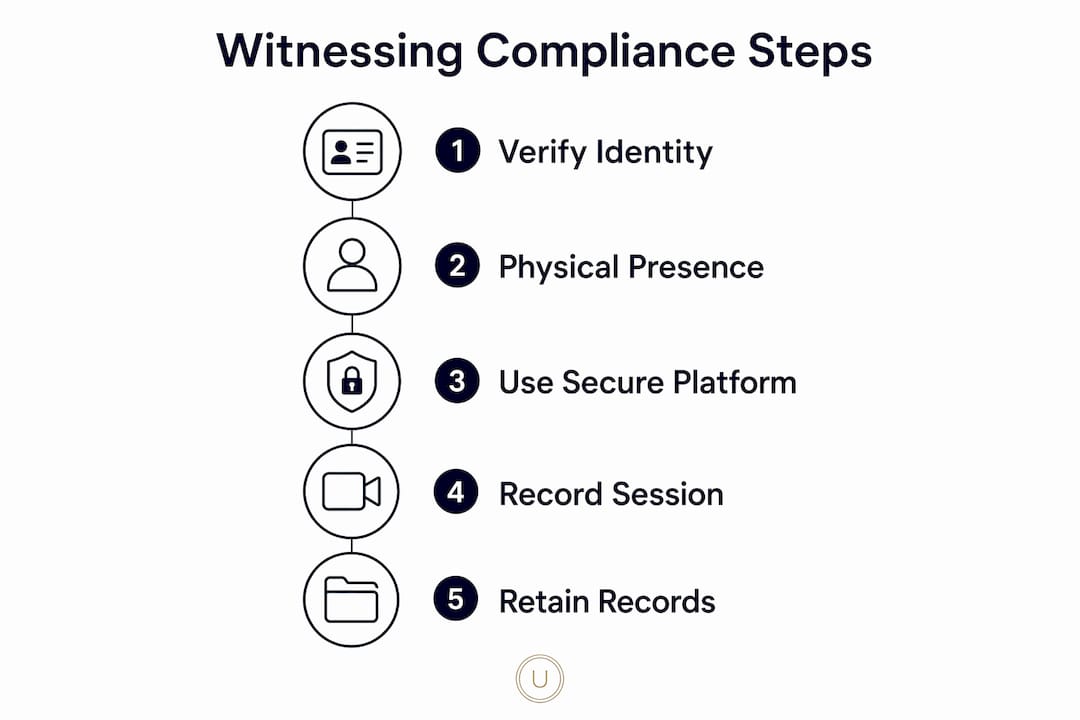
Physical presence vs remote witnessing
HM Land Registry requires the witness to be physically present in the same room as the signatory for UK property deeds. This rule applies even when the signature itself is applied electronically. Remote witnessing is permitted for some document types in certain jurisdictions, but it carries strict procedural requirements.
Accepted procedural steps for compliant electronic witnessing
- Select a purpose-built platform. Remote witnessing must use secure, approved platforms that integrate identity verification, tamper-evident logging, biometric checks, and session recordings. Generic video conferencing tools do not meet this standard.
- Verify all parties’ identities before signing. Multi-factor authentication, one-time passwords, and credential analysis are the accepted methods. Identity verification must be completed before the signing session begins.
- Conduct the signing session with the witness observing in real time. The witness must see the signatory apply their signature. For remote sessions, the platform must record the session and log all actions with timestamps.
- Apply the witness signature immediately after the principal signature. The witness signs in the same session, confirming they observed the act. Any gap in the session can compromise the audit trail.
- Generate and retain a tamper-evident audit trail. The platform must produce a log that records every action, timestamp, and identity verification step. This log is the primary evidence of compliance if the document is ever challenged.
- Obtain conveyancer certification where required. For UK property transactions using the Mercury signature process, the conveyancer certifies that the signing process was conducted correctly before submitting to HM Land Registry.
Pro Tip: If poor video or audio quality disrupts a remote witnessing session, restart the session and re-verify all parties’ identities before proceeding. Continuing with a degraded connection risks the legal validity of the entire document.
What are common pitfalls and legal risks in electronic witnessing?
Most errors in electronic witnessing are procedural, not technical. The platform may be compliant, but the process around it fails.
The most common pitfalls include:
- Choosing an interested witness. A witness with a financial stake in the document, such as a beneficiary or a spouse who stands to inherit, can void the entire document. This applies regardless of how secure the signing platform is. Witness impartiality is a legal requirement, not a platform feature.
- Assuming all documents can be witnessed remotely. Wills and testamentary documents generally require physical witnessing in most jurisdictions. Many solicitors incorrectly assume that pandemic-era remote witnessing concessions remain in force. They do not in all cases.
- Using consumer-grade video conferencing tools. A standard video call does not produce a tamper-evident session log, does not integrate identity verification, and does not generate a compliant audit trail. Using one for a witnessed deed creates an unenforceable document.
- Inadequate record retention. Electronic does not mean informal. Firms must retain the full audit trail, including identity verification records, session logs, and the signed document, for the same period as they would retain a wet-ink original.
- Failing to correct errors promptly. If a deed is signed with a procedural error, such as the witness signing before the principal, the document must be re-executed. Attempting to rely on a defective deed in a property transaction creates title risk that can take years to resolve.
Pro Tip: Build a pre-signing checklist into your workflow. Confirm witness eligibility, platform compliance, and identity verification steps before any session begins. A five-minute check prevents weeks of remediation.
How to implement electronic witness signature rules in legal and business workflows
Integrating compliant electronic witnessing into your practice requires a structured approach across platform selection, client preparation, and record management.
Step-by-step implementation framework
- Audit your current document types. Categorise every document your firm executes by whether it requires a witness, and whether physical or remote witnessing is permitted for that document type in the relevant jurisdiction.
- Select a compliant platform. Choose a platform that provides tamper-evident audit trails, integrated identity verification, multi-factor authentication, and session recording. For UK property work, confirm the platform supports the Mercury signature process and conveyancer-certified electronic signatures. SignFlow Now is built specifically for this purpose, combining legally binding e-signatures with AML screening and HMRC integration for regulated transactions.
- Prepare signatories and witnesses with written instructions. Send clear written guidance before every signing session. Specify where the witness must be located, what identity documents they need, and what they will be asked to do during the session.
- Complete conveyancer certification for UK property deeds. After the signing session, the conveyancer must certify the process in writing before submitting the executed deed to HM Land Registry. This step is mandatory, not optional.
- Apply a cross-border compliance checklist for international transactions. For transactions spanning the UK, US, EU, Canada, or Australia, use a cross-border signing checklist to confirm that the witnessing method satisfies the rules of every jurisdiction involved.
- Retain all records in line with your jurisdiction’s requirements. Store the signed document, the audit trail, identity verification records, and any conveyancer certification together. Treat this bundle as the legal equivalent of a wet-ink original.
The table below summarises the key compliance requirements by document type and jurisdiction.
| Document type | Witnessing requirement | UK standard | US standard |
|---|---|---|---|
| Commercial contract | None required | Electronic signature only | Electronic signature only |
| Property deed | Witness required | Physical presence mandatory | Varies by state |
| Power of attorney | Witness required | Physical or approved remote | Varies by state |
| Will | Witness required | Physical presence mandatory | Physical presence in most states |
| Statutory declaration | Witness required | Authorised person required | Notarisation typically required |
For e-signature property conveyancing specifically, the Mercury process remains the accepted standard in England and Wales. Deviating from it without HM Land Registry approval creates title defects that are difficult and costly to remedy.
Key takeaways
Electronic witness signature rules require physical presence, platform compliance, and witness impartiality to produce a legally enforceable witnessed document.
| Point | Details |
|---|---|
| Witnessing rules exceed signature rules | Documents such as deeds require both a valid electronic signature and a compliant witnessing process. |
| Physical presence remains mandatory for UK deeds | HM Land Registry requires the witness to be in the same room as the signatory, even for electronic signatures. |
| Witness impartiality is non-negotiable | A financially interested witness can void the entire document regardless of platform security. |
| Consumer tools are not compliant | Only purpose-built platforms with audit trails, identity verification, and session recording satisfy legal requirements. |
| Record retention is a legal obligation | Firms must retain the full audit trail alongside the signed document for the same period as a wet-ink original. |
Where electronic witnessing is heading: a practitioner’s view
The regulatory direction is clear: electronic witnessing is becoming more accepted, but the bar for compliance is rising, not falling. Regulators are not relaxing standards. They are codifying them.
What I find most instructive from years of working with legal professionals on signing compliance is that the firms that struggle most are not the ones using the wrong technology. They are the ones applying the right technology to the wrong process. A compliant platform cannot compensate for a witness who is a beneficiary, a session that was not recorded, or a conveyancer who skipped the certification step.
The pandemic accelerated remote witnessing adoption, and that acceleration exposed a gap between what technology can do and what the law actually permits. Many practitioners assumed that temporary concessions were permanent changes. They were not. The Law Commission’s position on deeds remains anchored to physical presence for UK property transactions, and HM Land Registry has not moved from that position.
My practical advice is this: invest in a platform that was built for legal compliance, not adapted to it. The difference shows up in the audit trail, in the identity verification workflow, and in the support you receive when a transaction is challenged. Generic tools create generic risk. The legal weight of an electronic signature depends directly on the strength of the identity verification behind it. That is not a technology question. It is a compliance decision.
— SignFlow Now
SignFlow Now: built for compliant electronic witnessing
Legal professionals managing deeds, property transfers, and regulated contracts need more than a basic signing tool.
SignFlow Now is an AI-native e-signature and compliance platform built specifically for solicitors, conveyancers, estate agents, and accountants operating across the UK, US, Canada, Australia, and the EU. It combines legally binding e-signatures with built-in AML screening, HMRC Agent Authorisation, tamper-evident audit trails, and client onboarding packs. Every signing session produces a compliant record that satisfies the evidential requirements of HM Land Registry, eIDAS, the ESIGN Act, and UETA. For law firm teams managing high volumes of witnessed documents, SignFlow Now provides the procedural controls and audit infrastructure that compliance requires.
FAQ
What documents require an electronic witness signature?
Deeds, powers of attorney, wills, and statutory declarations typically require a witness. Standard commercial contracts do not.
Can a deed be witnessed remotely in the UK?
No. HM Land Registry requires the witness to be physically present with the signatory for property deeds, even when the signature is applied electronically.
What makes a witness legally valid for electronic documents?
The witness must be an independent adult with no financial interest in the document. A beneficiary or spouse acting as witness can void the document entirely.
Is a video call sufficient for remote electronic witnessing?
No. Remote witnessing requires a secure, purpose-built platform with integrated identity verification, session recording, and tamper-evident logging. Consumer video tools do not meet this standard.
How long must electronic witnessing records be retained?
Firms must retain the signed document, the full audit trail, and identity verification records for the same period as a wet-ink original. The specific retention period depends on the document type and jurisdiction.
Recommended
- Cross-Border Signing Compliance Checklist: 2026 Guide | SignFlow Now
- eIDAS Compliant Signatures for Law Firms: 2026 Guide | SignFlow Now
- Are Electronic Signatures Legal in the US? ESIGN vs UETA Explained | SignFlow Now
- Are Electronic Signatures Legally Binding in the UK? The Definitive Answer | SignFlow Now