
Data protection estate agent rules: your 2026 guide

Data protection estate agent rules define the mandatory legal framework UK estate agents must follow to lawfully collect, use, and retain personal data in every property transaction. The formal term for this framework is UK GDPR, enacted through the Data Protection Act 2018 and reinforced by the Money Laundering Regulations 2017 (MLR 2017). Estate agents handle a wide range of personal data: buyer and seller identities, financial records, tenant references, and customer due diligence (CDD) files. Regulators including the Information Commissioner's Office (ICO), HMRC, Propertymark, and the National Trading Standards Estate and Letting Agent Team (NTSEAT) all hold enforcement powers. Non-compliance carries financial penalties and reputational damage that no agency can afford to ignore.
What are the key principles of data protection UK estate agents must follow?
UK GDPR sets out seven core principles that govern every data processing activity in your agency. Each principle carries a direct compliance obligation, not a general aspiration.
The principles most relevant to estate agency practice are:
- Lawfulness, fairness, and transparency. You must identify a valid lawful basis before collecting any personal data, and you must tell clients how their data will be used. Privacy notices must be highly specific to your agency's activities and the lawful basis for each processing operation. Generic template notices no longer satisfy ICO expectations.
- Purpose limitation. Data collected for one purpose cannot be repurposed without a fresh lawful basis. Buyer contact details gathered during a viewing cannot be used for unrelated marketing without separate consent.
- Data minimisation. Collect only what you genuinely need. Tenant reference checks require income verification; they do not require a full employment history unless directly relevant.
- Accuracy. Personal data must be kept up to date. Stale contact records or outdated financial assessments create both compliance and commercial risk.
- Storage limitation. Retention periods must be defined, documented, and enforced. Different data types attract different retention rules, which the next section covers in detail.
- Integrity and confidentiality. You must apply technical and organisational security measures proportionate to the risk. This includes encrypted file storage, access controls, and regular staff training.
- Accountability. You must be able to demonstrate compliance, not merely assert it. Documented policies, training records, and audit trails are the evidence regulators expect to see.
Special category data, such as health information in a disability-related tenancy adjustment, requires explicit consent or another Schedule 1 condition under the Data Protection Act 2018. Tenant references and AML CDD files often contain sensitive financial details that warrant the same careful handling.
Pro Tip: Review your privacy notice against each of the seven principles annually. If you cannot point to a specific lawful basis for every data type you collect, you have a gap that needs closing before an ICO audit.
How must estate agents manage data retention and deletion?
Data retention is where real estate data privacy obligations become most complex, because two separate legal regimes apply simultaneously and they do not always point in the same direction.

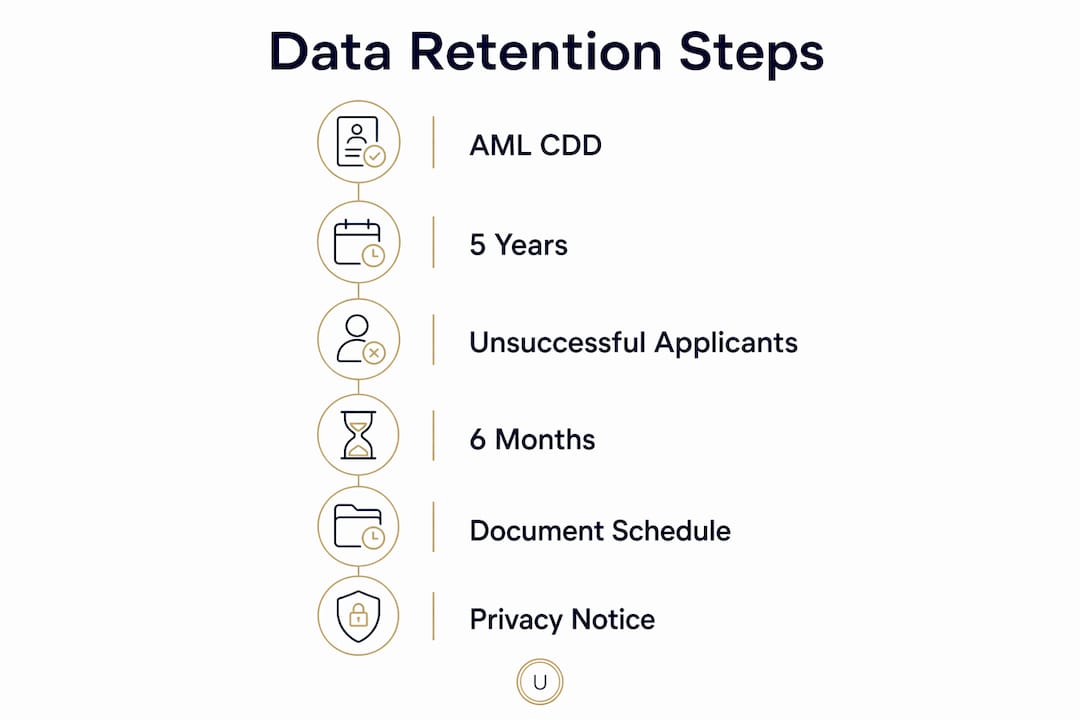
The MLR 2017 requires five-year retention of all CDD records from the date the business relationship ends or the transaction completes. This obligation legally overrides the UK GDPR right to erasure during that period. If a client requests deletion of their AML file within three years of a completed sale, you are legally required to refuse and to explain why in writing. You must document this override explicitly in your privacy notice.
For other data categories, the retention picture is different. Unsuccessful applicant data should be deleted within six months, and portal leads should be removed within twelve months if the contact does not proceed. Retaining these records beyond those periods without a documented justification puts you in breach of the storage limitation principle.
| Data type | Retention period | Legal basis |
|---|---|---|
| AML CDD records | 5 years post transaction | MLR 2017 (overrides GDPR erasure) |
| Unsuccessful applicant data | Up to 6 months | UK GDPR storage limitation |
| Portal leads (non-proceeding) | Up to 12 months | UK GDPR storage limitation |
| Signed agency agreements | Duration of contract plus 6 years | Limitation Act 1980 |
| Marketing consent records | Until consent withdrawn plus audit period | UK GDPR and PECR |
Documenting your retention schedule is not optional. The schedule must appear in your privacy notice, your Record of Processing Activities (ROPA), and your internal data handling procedures. Regulators treat an undocumented retention policy as no policy at all.
Pro Tip: Set automated deletion reminders in your case management system for each data category. Manual deletion processes fail under volume pressure. Automation removes the human error risk and creates a timestamped audit trail.
What lawful bases apply to common estate agency data processing activities?
Selecting the correct lawful basis is not a formality. It determines what rights clients hold over their data and what obligations you carry. The three bases most relevant to estate agency are contractual necessity, legitimate interest, and consent.
-
Contractual necessity. Processing is lawful when it is necessary to perform a contract with the data subject. Your agency agreement with a vendor or landlord provides this basis for core service activities: conducting valuations, preparing listings, managing viewings, and progressing sales. You do not need separate consent for these activities.
-
Legitimate interest. This basis applies when your interest in processing data is genuine, proportionate, and does not override the individual's rights. Following up on a portal enquiry, conducting quality assurance calls, and maintaining business records all typically qualify. However, you must complete a three-part Legitimate Interest Assessment (LIA) covering purpose, necessity, and balance before relying on this basis. The LIA must be documented and retained.
-
Consent. Marketing communications require explicit, separate consent with an affirmative action from the individual. Pre-ticked boxes and bundled consents are invalid under both UK GDPR and the Privacy and Electronic Communications Regulations 2003 (PECR). Consent must be recorded with a timestamp, IP address, and the version of the privacy notice shown at the point of capture.
-
Distinguishing service communications from marketing. Sending a buyer confirmation of their viewing appointment is a service communication and requires no separate consent. Sending that same buyer a newsletter about new listings is marketing and requires explicit opt-in. Conflating the two is one of the most common compliance errors agents make.
-
Joint controller arrangements. In lettings, failing to distinguish between data controllers and processors in joint arrangements risks regulatory breach under Article 26 UK GDPR. Where a letting agent and landlord both determine the purposes of processing, a written joint controller agreement is required. This agreement must be transparent and accessible to tenants.
How do AI chatbots affect estate agents' data protection duties?
AI chatbots introduce a layer of compliance complexity that many agencies have not yet addressed. When a chatbot collects a visitor's name, contact details, and property requirements, that collection is a data processing activity subject to full UK GDPR obligations.
The compliance steps you must take when deploying a chatbot include:
- Data flow mapping. Map every data point the chatbot collects and integrate these flows into your ROPA. Regulators expect your ROPA to reflect your actual processing, not just your traditional activities.
- Privacy notice updates. Add a specific supplement to your privacy notice covering chatbot data collection, the lawful basis used, and how long that data is retained. A generic notice that does not mention AI data collection is non-compliant.
- Separate opt-in for marketing. If the chatbot asks whether a visitor wants property alerts or newsletters, that opt-in must be a distinct, affirmative action. It cannot be bundled with the chatbot's terms of use.
- Data Processing Agreements. Sign a formal Data Processing Agreement (DPA) with your chatbot provider before going live. The provider processes personal data on your behalf, making them a data processor under UK GDPR.
- Subject Access Request (SAR) handling. When a client submits a SAR, you must include chatbot conversation logs in your response. Ensure your chatbot provider can extract and supply this data promptly.
- Automated deletion. Configure the chatbot's data retention settings to align with your documented retention schedule. Chatbot data that sits indefinitely in a third-party system is a storage limitation breach.
The ROPA and LIA are baseline compliance documents now regarded as necessary by the ICO and HMRC for any estate agent processing personal data beyond explicit consent. AI tools make maintaining these documents more urgent, not less.
What practical steps can UK estate agents take to maintain compliance in 2026?
Compliance is not a one-time exercise. The following steps reflect current ICO and HMRC enforcement expectations for estate agents operating in 2026.
-
Register with the ICO and pay the correct fee. ICO registration is mandatory for all estate agents processing personal data. Fees are tiered from £40 to £2,900 depending on your organisation's size and turnover. Failure to register is a criminal offence, not merely a civil penalty.
-
Implement and document staff training. Evidence-led compliance with documented staff training and audit trails is required under current HMRC and ICO enforcement strategies. Training records must show who was trained, on what topic, and when. Annual refreshers are the minimum standard; quarterly updates are advisable when regulations change.
-
Maintain audit trails on data access and processing. Log who accessed which client records and when. This is particularly critical for AML CDD files, where HMRC can request evidence of your due diligence process during a supervision visit.
-
Review cookie banners and privacy notices. Your website's cookie consent mechanism must give visitors a genuine choice. Pre-selected cookies and consent walls that block access unless cookies are accepted are non-compliant. Your privacy notice must be visible, specific, and current.
-
Obtain written consent before publishing property photographs. Estate agents must secure written consent from occupants before publishing identifiable property photos online. This applies where photographs show personal items, family photos, or other details that could identify the occupant. Document this consent in the instruction file.
-
Ensure listing accuracy under the DMCC Act 2024. The Digital Markets, Competition and Consumers Act 2024 imposes new obligations on the accuracy of property listings. Misleading descriptions or omitted material information can now attract enforcement action from the CMA as well as NTSEAT. Accurate listings are both a consumer protection and a data accuracy obligation.
For agents handling AML compliance for estate agents under MLR 2017, maintaining a clear audit trail from client onboarding through to transaction completion is the single most effective way to demonstrate compliance to HMRC supervisors.
Key takeaways
UK estate agents must meet overlapping obligations under UK GDPR, the Data Protection Act 2018, and the Money Laundering Regulations 2017, with documented evidence of compliance required by both the ICO and HMRC.
| Point | Details |
|---|---|
| AML retention overrides GDPR erasure | CDD records must be kept for 5 years post transaction, regardless of client deletion requests. |
| Lawful basis must be documented per activity | Contractual necessity, legitimate interest, and consent each apply to different estate agency tasks. |
| Privacy notices must be specific | Generic templates do not satisfy ICO requirements; notices must name the lawful basis for each processing operation. |
| AI chatbots require additional compliance steps | Chatbot data flows must appear in your ROPA, with a signed DPA and separate marketing opt-in. |
| ICO registration is a legal requirement | All estate agents must register and pay the correct tiered fee; non-registration is a criminal offence. |
SignFlow Now's view on data protection in estate agency
The compliance challenge most agents underestimate is not understanding the rules. It is proving they follow them. Regulators do not accept verbal assurances. They ask for training logs, ROPA entries, LIA documents, consent timestamps, and deletion records. Agents who cannot produce these on request face enforcement action regardless of their actual intentions.
The most common mistake we see is treating privacy notices as a box-ticking exercise. A notice copied from a template and never updated is worse than useless. It signals to the ICO that your agency has not engaged seriously with its obligations. The ICO now expects notices that name the specific lawful basis for each processing activity, reference your retention schedule, and explain how clients exercise their rights.
The second common failure is poor demarcation of data controller responsibilities in joint lettings arrangements. Where a landlord and agent both influence how tenant data is used, both are joint controllers under Article 26 UK GDPR. Without a written agreement, both parties carry full liability for any breach.
The arrival of AI tools in estate agency has accelerated the compliance burden rather than reduced it. Every new technology that touches personal data requires a fresh data flow map, a ROPA update, and a privacy notice revision. Agents who treat compliance as a periodic task rather than a continuous process will find themselves permanently behind the regulatory curve. The agents who manage this well are those who build compliance into their daily workflows, not those who scramble before an audit.
— SignFlow Now
How SignFlow Now supports estate agent compliance
Estate agents managing data protection obligations across AML screening, consent capture, and document retention need a platform that keeps pace with regulatory demands.
SignFlow Now combines legally binding e-signatures with AML screening, Right to Rent verification, and HMRC integration in a single platform built for UK estate agents. Every signed document generates a timestamped audit trail, supporting both ICO accountability requirements and HMRC supervision visits. Consent capture at the point of signing is recorded with the privacy notice version shown, making your marketing consent records audit-ready from day one. For agencies managing compliance across teams, SignFlow Now's workflow tools keep training records, CDD files, and retention schedules in one documented, accessible place.
FAQ
What data protection laws apply to UK estate agents?
UK estate agents are subject to UK GDPR, the Data Protection Act 2018, the Money Laundering Regulations 2017, and the Privacy and Electronic Communications Regulations 2003. The ICO and HMRC both hold enforcement powers over different aspects of these obligations.
How long must estate agents keep AML records?
The Money Laundering Regulations 2017 require estate agents to retain customer due diligence records for five years from the end of the business relationship or transaction. This period overrides the UK GDPR right to erasure.
Do estate agents need to register with the ICO?
Yes. All estate agents processing personal data must register with the ICO and pay a tiered annual fee ranging from £40 to £2,900. Failure to register is a criminal offence under the Data Protection Act 2018.
What lawful basis covers estate agent marketing emails?
Marketing emails require explicit, separate consent under UK GDPR and PECR. Pre-ticked boxes and bundled consents are invalid. Consent must be recorded with a timestamp, IP address, and the version of the privacy notice shown at the point of capture.
Do AI chatbots on estate agent websites require special compliance steps?
Yes. Chatbot data flows must be mapped and included in your ROPA. You must update your privacy notice to cover chatbot data collection, sign a Data Processing Agreement with the chatbot provider, and configure automated deletion aligned with your retention schedule.
Recommended
- Right to Rent Checks in 2026: What Estate Agents Must Do Differently | SignFlow Now
- Suspicious Transaction Estate Agent: 2026 Compliance Guide | SignFlow Now
- AML Compliance for Estate Agents: Screening Buyers, Sellers and Landlords Under MLR 2017 | SignFlow Now
- Electronic Signature Realtor Legality: 2026 Compliance Guide | SignFlow Now