
Remote notarisation in real estate: your 2026 guide

Remote online notarisation (RON) is the process by which a licensed notary authenticates signatures and verifies identities through a secure, live video session, making physical presence unnecessary for real estate closings. Known formally as remote online notarisation, this method is now authorised in over 40 US states and has become a recognised standard for property transactions. It relies on three core pillars: real-time identity verification, video recording of the entire session, and a tamper-evident digital seal applied using Public Key Infrastructure (PKI). For homebuyers and real estate investors, understanding what remote notarisation in real estate means in practice is the difference between a closing that completes in days and one that stalls for weeks.
What is remote notarisation in real estate, and how does it work?
Remote online notarisation in real estate follows a structured process. Each step is governed by state-level statutes and platform-specific compliance requirements, so knowing the sequence helps you prepare properly.
-
Document preparation. Your solicitor, title company, or settlement agent uploads the relevant real estate documents to a RON-enabled platform. These typically include the deed, mortgage note, and any ancillary closing paperwork.
-
Scheduling the session. You book a session with a certified online notary who holds a valid commission in the authorising state. Most platforms offer same-day or next-day availability, which directly supports faster closings.
-
Identity verification. At the start of the session, you complete a multi-factor identity check. This usually involves credential analysis of a government-issued photo ID and knowledge-based authentication (KBA), a series of questions drawn from public records that only you should be able to answer.
-
Live video signing. The notary witnesses your electronic signature in real time via a secure video call. You apply your e-signature to each document while the notary observes and confirms your identity and willingness.
-
Application of the notarial seal. The notary applies a digital notarial seal to the document. This seal is cryptographically linked to the document using PKI, meaning any subsequent alteration is immediately detectable.
-
Session recording and storage. The entire video session is recorded and stored securely. This creates a permanent audit trail that is more secure than traditional notarisation because it deters fraud and provides irrefutable evidence of the signing event.
-
Document delivery. The notarised documents are delivered electronically to the relevant parties, including the title company, lender, and county recorder's office.
RON sessions typically last 15–30 minutes. That brevity, combined with same-day scheduling, is one of the primary reasons investors and cash buyers favour this method.
Pro Tip: Before your session, test your webcam, microphone, and internet connection. A failed video call mid-signing can invalidate the session and require rescheduling, which delays your closing.

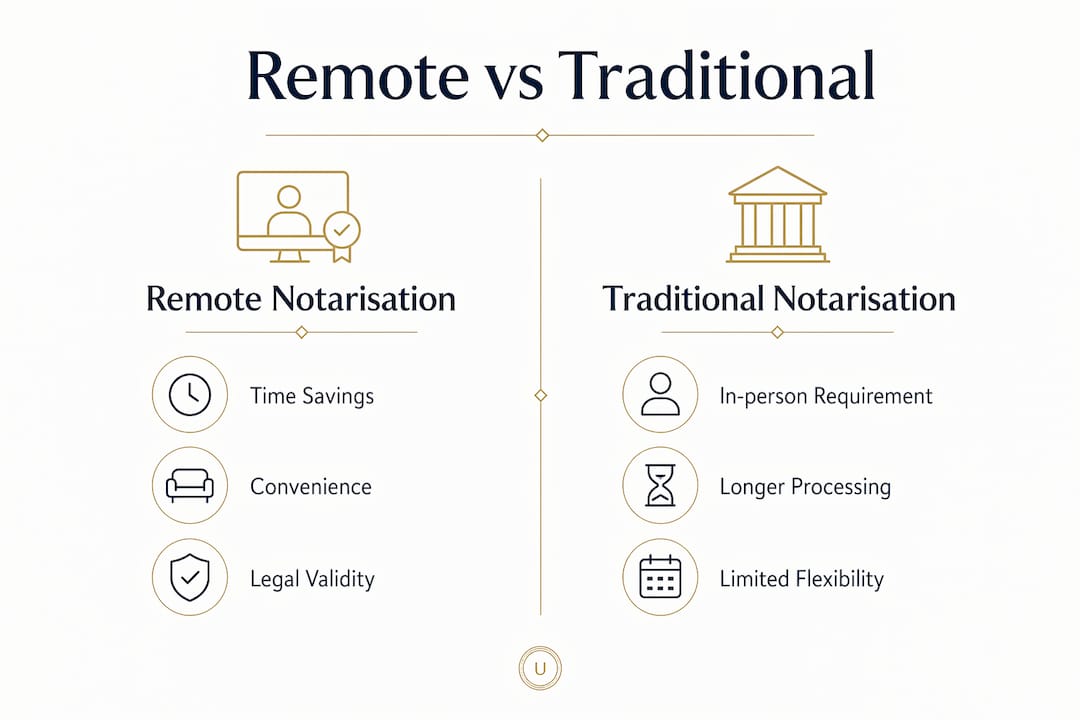
What are the benefits of remote notarisation compared to traditional methods?
The benefits of remote notarisation for real estate transactions are concrete and measurable, not simply a matter of convenience.
-
Faster closings. RON has cut typical closing timelines from 14–21 days to as little as 7 days for cash buyers. That acceleration matters enormously for investors who need to move quickly on competitive properties.
-
No travel required. You can sign from any location with a reliable internet connection. This removes scheduling conflicts, eliminates travel costs, and makes cross-country or international property purchases significantly more practical.
-
Lower cost per document. The typical cost for remote notarisation of real estate documents runs from £20 to £30 per document (approximately $25 to $39). That figure is modest relative to total closing costs and far cheaper than the time lost to in-person delays.
-
Superior security. RON sessions are recorded in full and cryptographically sealed. Security in RON sessions exceeds traditional notarisation because multi-factor digital identity verification and permanent video records deter fraud in ways that a paper-based process cannot.
-
Geographic flexibility. A buyer in London can close on a property in Texas without boarding a flight. This is particularly valuable for international investors and expatriates purchasing US real estate.
"Remote online notarisation is not just a convenience. It represents the removal of friction in real estate closings, making remote workflows an expected norm for speed and flexibility. For investors and homebuyers alike, it redefines what a timely closing looks like."
Most major mortgage lenders and title insurance underwriters, including First American and Fidelity National, now accept remotely notarised documents in authorising states. That broad institutional acceptance confirms RON's status as a mainstream closing tool rather than a niche workaround.
What legal and logistical nuances affect remote notarisation in real estate?
RON is legal in over 40 US states, but legal authorisation at the state level does not guarantee smooth acceptance at every point in your transaction. The practical barriers are more granular than the statutory framework suggests.
State-level variation and document eligibility
Not every state permits RON for every document type. Certain states, including Georgia, South Carolina, and Florida, require remote witness participation for some real estate deeds. This means your RON platform must support remote witnesses, not just the notary and signer. If your platform lacks that capability, your deed may be legally defective even if the notary is properly commissioned.
Cross-state transactions add another layer of complexity. Cross-state real estate transactions are governed by the most restrictive jurisdiction's rules. If the state where the property is recorded does not authorise RON, or imposes requirements your session did not meet, the notarisation may be invalid regardless of where you signed.
County recorder and eRecording acceptance
State law authorising RON does not compel county recorders to accept electronically sealed documents. Confirming county recorder acceptance of electronically sealed PDFs before your session is critical. A recorder without eRecording capability will reject your document, forcing manual reprocessing and delaying your closing.
| Acceptance point | What to confirm |
|---|---|
| County recorder | Accepts electronically sealed PDFs via eRecording |
| Mortgage lender | Has a written policy permitting RON documents |
| Title company | Is equipped to process and insure RON closings |
| State law | Authorises RON for the specific document type |
Lender policy variation
The main barrier to RON is not legal prohibition but uneven acceptance by individual lenders and recorders. National lenders generally embrace RON. Local and regional lenders may still require traditional in-person notarisation, regardless of state law. Verifying your lender's written policy is the single most important preparatory step before scheduling a RON session.
Pro Tip: Request written confirmation from your lender, title company, and county recorder that they accept RON documents before you book your session. A verbal assurance is not sufficient protection if a dispute arises at closing.
How to prepare for remote notarisation as a homebuyer or investor
Preparation determines whether your RON session completes cleanly or requires costly rescheduling. The following steps apply whether you are a first-time buyer or an experienced investor closing on your tenth property.
-
Verify the notary's credentials. Confirm that your notary holds a valid commission in the authorising state and is registered on a compliant RON platform. Platforms operating under the ESIGN Act and UETA provide a useful baseline for e-signature compliance in real estate, but RON requires additional state-specific authorisation.
-
Communicate early with all parties. Contact your lender, title company, and settlement agent at the outset to confirm RON acceptance. Successful adoption of remote notarisation depends on coordinated communication among all transaction parties. Do not assume acceptance; confirm it in writing.
-
Prepare your identification. Have a valid, government-issued photo ID ready. Most platforms require a passport or driving licence. Expired documents will fail the credential analysis stage and abort the session.
-
Digitise your documents in advance. Ensure all documents are in the correct digital format before the session. Uploading poorly scanned or incorrectly formatted files wastes session time and can trigger compliance flags.
-
Confirm witness requirements. If your state or document type requires remote witnesses, arrange for them to join the video session. Witnesses must also complete identity verification on most platforms.
-
Check eRecording capability. Investors and buyers should verify that the county recorder supports eRecording of RON documents before the session takes place. Failure to confirm this can force manual processing and delay closings significantly.
Staying compliant with state regulations for remote notarisation requires attention to detail at every stage. The process is straightforward when all parties are aligned, but a single unconfirmed acceptance point can unravel an otherwise well-prepared closing.
Key takeaways
Remote online notarisation is legally valid in over 40 US states and cuts closing timelines significantly, but its success depends entirely on confirming acceptance with every party in the transaction chain before the session begins.
| Point | Details |
|---|---|
| RON is widely authorised | Over 40 US states permit remote online notarisation for real estate documents by 2026. |
| Sessions are fast and secure | RON sessions last 15–30 minutes and use PKI-based digital seals to prevent document tampering. |
| Acceptance is the critical variable | Confirm written acceptance from your lender, title company, and county recorder before booking. |
| Costs are modest | Remote notarisation typically costs $25–$39 per document, well below the cost of closing delays. |
| Cross-state rules apply | The most restrictive jurisdiction's requirements govern cross-state transactions. |
The practical reality of RON in 2026: a SignFlow Now perspective
The conversation around remote notarisation tends to focus on what the technology enables. What gets less attention is where it still fails, and why.
From working with real estate professionals across the US, UK, and Australia, the pattern is consistent. The technology works. The legal framework, in most US states, is solid. The failure point is almost always coordination. A buyer completes a flawless RON session, the documents are properly sealed and delivered, and then the county recorder's office rejects the filing because it does not yet support eRecording. The closing stalls. The buyer is frustrated. The notary did everything correctly.
This is not a technology problem. It is a communication problem, and it is entirely preventable.
The transactions that close without incident share one characteristic: every party confirmed their acceptance of RON documents before the session was scheduled. That confirmation took ten minutes. The alternative, reprocessing a rejected filing, took ten days.
RON will become the standard for real estate closings. The trajectory is clear. But the professionals who benefit most from it now are those who treat the pre-session checklist with the same rigour they apply to the documents themselves. The technology is ready. The question is whether your transaction chain is.
— SignFlow Now
How SignFlow Now supports real estate professionals with compliant e-signatures
Real estate professionals handling remote closings need more than a video call and a digital stamp. They need a platform that combines legally binding e-signatures with built-in compliance checks from the moment a document is opened.
SignFlow Now is built for exactly this environment. The platform integrates e-signatures compliant with the ESIGN Act, UETA, and eIDAS with AML screening, client onboarding packs, and payment collection at the point of signing. For real estate agents and realtors handling multiple closings simultaneously, that integration removes the manual compliance steps that slow transactions down. Teams working across multiple jurisdictions can manage the full signing workflow from a single platform, with every session logged and auditable. Visit SignFlow Now to see how the platform supports compliant real estate transactions across the US, UK, Canada, Australia, and EU markets.
FAQ
What is remote notarisation in real estate?
Remote notarisation in real estate is the process of authenticating property transaction documents through a live, secure video session with a licensed notary, without requiring physical presence. The notary verifies identity, witnesses electronic signatures, and applies a tamper-evident digital seal.
Is remote notarisation legal for real estate documents?
Remote online notarisation is authorised in over 40 US states for real estate documents, though eligibility varies by document type and state. Always confirm that the property's recording state permits RON for your specific document before proceeding.
How long does a remote notarisation session take?
A typical RON session for real estate documents lasts 15–30 minutes. Preparation, including identity verification and document upload, should be completed before the session begins to avoid delays.
Do all lenders and title companies accept remotely notarised documents?
Most major national lenders and title insurance underwriters accept RON documents in authorising states, but local and regional lenders may still require in-person notarisation. Confirm your lender's written policy before scheduling a session.
What happens if the county recorder does not support eRecording?
If the county recorder lacks eRecording capability, electronically sealed RON documents will be rejected, requiring manual reprocessing and potentially delaying your closing by days or weeks. Confirm eRecording acceptance with the recorder's office before your session.
Recommended
- E-Signatures for US Real Estate Agents: ESIGN, UETA and What Realtors Need to Know | SignFlow Now
- Electronic Signature Realtor Legality: 2026 Compliance Guide | SignFlow Now
- Right to Rent Checks in 2026: What Estate Agents Must Do Differently | SignFlow Now
- Suspicious Transaction Estate Agent: 2026 Compliance Guide | SignFlow Now