
What is e-signature law? A guide for legal professionals

E-signature law is the body of statute and regulation that grants electronic signatures the same legal force as handwritten ones, making them valid and enforceable in commerce and legal transactions. For solicitors, accountants, estate agents, and business owners operating across multiple jurisdictions, understanding what is e-signature law means understanding which rules govern your documents, which signatures carry evidential weight, and where the law draws a firm line. The two most significant frameworks are the US ESIGN Act and the EU eIDAS Regulation, and both rest on the same core principle: intent and consent, not ink, determine validity.
What statutory laws govern electronic signatures?
Electronic signature law operates through a layered system of national and regional statutes. Each jurisdiction sets its own threshold for validity, but the underlying principles are consistent.
In the United States, the ESIGN Act sets a national baseline, confirming that electronic signatures carry the same legal weight as handwritten ones in interstate and foreign commerce. The Uniform Electronic Transactions Act (UETA) supplements this at state level, with 48 states plus the District of Columbia having adopted it. That near-universal adoption means a digitally signed contract executed in New York is enforceable in California under the same statutory framework.
The EU's eIDAS Regulation takes a more structured approach, defining three tiers of electronic signature:
- Simple electronic signature (SES): Any electronic data attached to or associated with a document to indicate agreement. A typed name in an email qualifies. Legally valid but carries the lowest evidential weight.
- Advanced electronic signature (AES): Uniquely linked to the signatory, capable of identifying them, and created using data under the signatory's sole control. Requires cryptographic binding and is detectable if the document is altered after signing.
- Qualified electronic signature (QES): Created with a qualified electronic signature creation device and based on a qualified certificate. QES carries the highest legal weight under eIDAS and is equivalent to a handwritten signature across all EU member states.
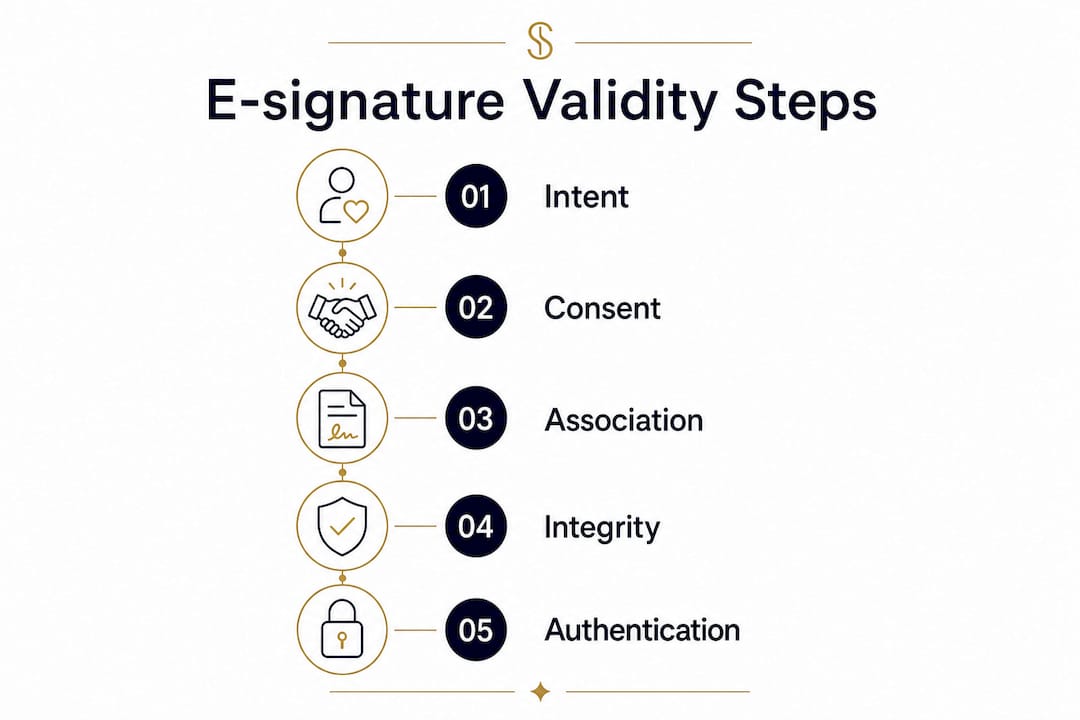
For a signature to be valid under either the ESIGN Act or eIDAS, three conditions must be met. First, the signatory must demonstrate clear intent to sign. Second, all parties must consent to conduct the transaction electronically. Third, the signature must be logically associated with the document being signed. The law focuses on intent and consent over cryptographic methods, which means a checkbox or a typed name can be as legally effective as a certificate-based signature if those conditions are satisfied.
Pro Tip: If your practice handles cross-border transactions between the UK, EU, and US, map each document type to the relevant jurisdiction's signature tier before choosing your signing method. A QES required under eIDAS will not automatically satisfy a US court's evidential expectations, and vice versa.

What are the common limitations and exclusions in e-signature law?
Electronic signature law does not apply universally. Specific document categories remain excluded from statutory protection in most jurisdictions, and practitioners who overlook these carve-outs face the risk of unenforceable agreements.
The most commonly excluded categories include:
- Wills and codicils: Testamentary documents require wet-ink signatures and physical witnesses in the UK, US, and most Commonwealth jurisdictions. Common carve-outs include testamentary documents and family law proceedings.
- Family law matters: Adoption orders, certain divorce proceedings, and court-issued family orders typically require physical formalities.
- Negotiable instruments: Under the Uniform Commercial Code (UCC), certain financial instruments such as promissory notes and bills of exchange are excluded from ESIGN applicability. UCC negotiable instruments and specific financial regulations preclude electronic signatures in these contexts.
- Court orders and notices: Many jurisdictions require physical service and wet-ink judicial documents.
- Real property conveyances in some US states: Certain states impose additional formality requirements beyond ESIGN's baseline.
Jurisdiction-specific carve-outs add further complexity. A document type that is electronically signable in England and Wales may require a wet-ink signature in Scotland or a notarised signature in certain EU member states. For practitioners advising clients on cross-border transactions, this is not a theoretical risk. It is a live compliance obligation.
The practical implication is straightforward: before deploying an electronic signature on any document, verify its category against the applicable statute in each relevant jurisdiction. Relying on a general assumption that "e-signatures are legal" without checking document-specific exclusions is the most common compliance failure in professional services firms.
Pro Tip: Maintain a document classification register within your practice. Categorise each document type by jurisdiction, signature tier required, and whether it falls within a statutory exclusion. Review it annually as legislation evolves.
How does evidential weight affect the legal strength of e-signatures?
Statutory acceptance of an electronic signature is the starting point, not the finish line. The real test comes when a signature is challenged in court or in a regulatory investigation.
E-signature law is technology-neutral by design. That means a simple typed name satisfies the legal definition of an electronic signature if intent and consent are present. However, failing to retain verifiable audit trails significantly increases risk during disputes, despite the signature's technical legality. The absence of an audit trail places the burden of proof squarely on the party asserting the signature's authenticity.
The following steps strengthen evidential weight in any jurisdiction:
- Capture metadata at the point of signing. Record the signatory's IP address, the timestamp, the device used, and the geolocation where available. This data forms the factual backbone of any evidential challenge.
- Record consent explicitly. Document that the signatory agreed to conduct the transaction electronically, including confirmation that they could access and retain the signed document. Consumer consent under ESIGN is critical, especially for regulated disclosures.
- Use tamper-evident formats. PDF/A and PAdES (PDF Advanced Electronic Signatures) formats lock document content after signing and flag any post-signature alteration. These are the recognised standards for long-term document preservation in both the EU and UK.
- Apply identity verification proportionate to risk. A low-value commercial agreement may justify a simple e-signature. A high-value property transaction or regulated financial disclosure warrants an advanced or qualified signature with identity verification.
Simple electronic signatures are admissible but do not guarantee document integrity or signer identity without additional measures. Advanced and qualified signatures add cryptographic binding and strong identity verification, which is why they carry greater weight in contested proceedings. The ESIGN Act does not mandate audit trails as a statutory requirement, but industry practice treats them as non-negotiable for any document that may face legal scrutiny.
Pro Tip: Treat your audit trail as a legal document in its own right. Store it separately from the signed document, in a format that cannot be altered, and retain it for at least as long as the underlying agreement's limitation period.
How to apply e-signature laws practically in business and legal transactions
Compliance with electronic signature regulations requires more than selecting a signing platform. It requires a deliberate process built around document classification, consent management, and storage standards.
The following framework applies across UK, US, EU, Canadian, and Australian jurisdictions:
- Classify every document before signing. Identify the applicable statute, the required signature tier, and whether any exclusion applies. For UK solicitors, refer to the Law Society's practice notes alongside the Electronic Communications Act 2000 and the retained eIDAS framework post-Brexit. For US attorneys, cross-reference the ESIGN Act with state-level UETA adoption and any sector-specific rules from the SEC, FINRA, or CFPB.
- Obtain and record consumer consent. Under the ESIGN Act, the consent process must inform consumers of their right to receive paper copies and their right to withdraw consent. This is not optional. A transaction where consent was not properly obtained can be invalidated regardless of the signature's technical validity.
- Match signature tier to transaction risk. Use the eIDAS tiered model as a risk management benchmark even for US and UK transactions. Low-risk, routine agreements suit simple e-signatures. Regulated disclosures, high-value contracts, and cross-border transactions warrant advanced or qualified signatures.
- Store documents in compliant formats. PAdES is the recognised standard for long-term electronic signature preservation. It embeds the signature, certificate, and timestamp within the PDF, ensuring the document remains verifiable decades after signing.
- Audit your process regularly. Electronic signature regulations evolve. The UK's post-Brexit eIDAS framework, the EU's eIDAS 2.0 rollout, and state-level legislative changes in the US all require periodic review of your signing workflows.
The table below summarises the signature tier appropriate for common transaction types across key jurisdictions:
| Transaction type | Recommended tier | Jurisdiction note |
|---|---|---|
| Standard commercial contract | Simple e-signature | UK, US, EU, Canada, Australia |
| Regulated financial disclosure | Advanced e-signature | US (ESIGN/FINRA), EU (eIDAS AES) |
| High-value property transaction | Advanced or qualified | UK, EU; state-specific in US |
| Cross-border corporate agreement | Qualified e-signature | EU mandatory; best practice globally |
| Testamentary or family law document | Wet-ink signature required | All jurisdictions |
Key takeaways
E-signature law grants electronic signatures legal parity with handwritten ones, but evidential strength, document classification, and jurisdiction-specific exclusions determine whether that parity holds under scrutiny.
| Point | Details |
|---|---|
| Statutory validity | ESIGN Act, UETA, and eIDAS grant e-signatures legal force when intent and consent are proven. |
| Signature tiers matter | Match the signature tier (simple, advanced, or qualified) to the transaction's risk profile and jurisdiction. |
| Exclusions are firm | Wills, family law orders, and UCC negotiable instruments remain outside e-signature law in most jurisdictions. |
| Audit trails are critical | Metadata, timestamps, and consent records determine evidential strength when a signature is challenged. |
| Consent must be documented | Under ESIGN, consumer consent must be explicit, informed, and retained as part of the transaction record. |
SignFlow Now's perspective on e-signature law in 2026
The legal profession has largely accepted that electronic signatures are valid. What it has not yet accepted is that validity and enforceability are two different things. A signature can be legally valid under the ESIGN Act or eIDAS and still fail in a contested proceeding because the audit trail was incomplete, the consent record was missing, or the wrong signature tier was used for the transaction type.
The emergence of eIDAS 2.0 and European Digital Identity Wallets changes this calculus significantly. Qualified electronic signatures will become accessible without dedicated hardware, which means the cost barrier to high-assurance signing is falling. Firms that have relied on simple e-signatures for high-value transactions because QES was operationally inconvenient will need to reassess that position.
The most underappreciated risk in e-signature compliance is not the document that gets challenged. It is the document that gets challenged five years after signing, when the platform used to create it no longer exists, the audit trail was not exported, and the metadata cannot be reconstructed. Risk-based signature selection is not bureaucracy. It is the difference between a signed document and a provable one.
For legal professionals advising clients on e-signature admissibility, the practical advice is this: build your signing process around the worst-case evidential scenario, not the average transaction. The law gives you the framework. Your process determines whether you can use it.
— SignFlow Now
SignFlow Now: built for e-signature compliance across every jurisdiction
Legal professionals and business owners who need more than a basic signing tool will find that SignFlow Now is built specifically for the compliance demands this article describes.
SignFlow Now combines legally binding e-signatures with built-in audit trails, AML screening, Right to Rent verification, HMRC Agent Authorisation, and client onboarding packs. It operates across UK, US, Canada, Australia, and EU markets, with compliance frameworks covering MLR 2017, eIDAS, ESIGN Act, UETA, AUSTRAC, FINTRAC, and AMLD6. For firms that need to match signature tier to transaction risk, retain verifiable consent records, and meet multi-jurisdictional obligations, SignFlow Now handles the process end to end. Explore the full platform for teams to see how it fits your practice's workflow.
FAQ
What is e-signature law in simple terms?
E-signature law is the body of statute that gives electronic signatures the same legal validity as handwritten ones, provided intent and consent are demonstrated. The ESIGN Act governs the US, eIDAS governs the EU, and equivalent frameworks apply in the UK, Canada, and Australia.
Are all electronic signatures legally binding?
Most electronic signatures are legally binding under the ESIGN Act, UETA, or eIDAS when intent, consent, and document association are present. Exceptions apply to wills, certain family law documents, and UCC negotiable instruments, which require wet-ink signatures.
What is e-signature admissibility in court?
E-signature admissibility depends on the quality of the audit trail, the signature tier used, and whether consent was properly documented. Simple e-signatures are admissible but carry lower evidential weight than advanced or qualified signatures with verified identity records.
Do e-signature laws vary by US state?
The ESIGN Act sets a federal baseline, but state-level variations exist under UETA and sector-specific regulations. Certain states impose additional formality requirements for real property transactions, and some documents remain excluded regardless of state adoption.
What documents cannot be signed electronically?
Wills, codicils, adoption orders, certain court orders, and UCC negotiable instruments are commonly excluded from e-signature law across most jurisdictions. Always verify document-specific exclusions under the applicable statute before proceeding with electronic signing.